The Best Image to Video Sites of 2026
Last Updated: 14-Oct-2026Why image to video sites keep drawing attention
Image to video sites sit in an interesting corner of adult browsing because they turn a still idea into something that feels more immediate. A single photo, character render, or selfie style image can become a short looping clip, a guided scene, or a moving fantasy with very little setup. That shift from static to animated is what makes this category stand out. It is not quite the same as traditional video browsing, and it does not feel exactly like image galleries either. It sits somewhere in between, where the user has more influence over the mood and direction.
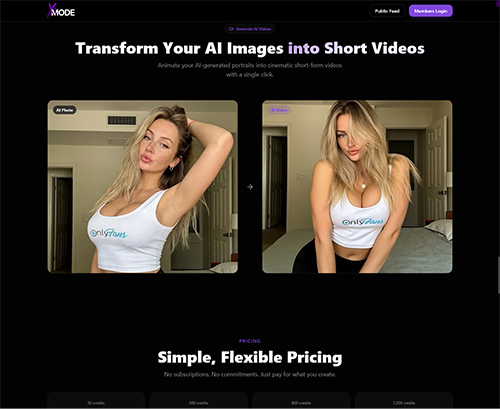
After spending time across different sites in this space, the biggest difference is not always raw output quality. It is often the overall feel of the process. Some sites are built around speed, where you upload an image, choose a motion style, and wait a minute or two for a result. Others are slower and more hands on, with text prompts, motion sliders, face consistency settings, and scene controls that ask for a bit more patience. In both cases, the appeal comes from watching a familiar image become something active, even if the clip is short and the movement is limited.
This niche also attracts a mix of users. Some are experimenting with fantasy scenarios that standard tube sites do not really cover. Others are more interested in custom character work, soft roleplay scenes, or turning AI generated art into short animated loops. The common thread is control. People come here because they want something more specific than whatever happens to be uploaded elsewhere, and these tools give them a way to shape that.
How these platforms feel to use
Most image to video sites follow a fairly simple pattern at first. You upload a source image or pick one from a built in gallery, then choose how much motion you want, what kind of camera movement to simulate, and sometimes what expression or body action should be emphasized. On the surface, that sounds straightforward, but the actual experience varies a lot from one site to another. Some interfaces are clean and almost minimal, which makes them easy to pick up even if the final clips are fairly basic. Others are crowded with options and generation tabs, and they can feel more like a workshop than a casual browsing tool.
A lot depends on how much the site lets you guide the result without making the process clumsy. The better ones usually strike a middle ground. They offer a prompt field, a few motion settings, duration choices, and maybe a way to steer intensity or camera framing, but they do not bury the user in technical language. Sites that go too far in the direction of automation can feel repetitive, since many outputs start to share the same small set of gestures. Sites that lean too hard into manual control can feel slow, especially when each failed generation costs credits.
Another thing you notice quickly is how these platforms handle consistency. Some are decent at preserving the look of a face or character across a short clip, while others drift after a few seconds and end up changing details that the user probably wanted to keep. That matters more here than it might in other AI categories, because adult content often depends on a very specific look, expression, or setup. If a site keeps the source image recognizable while adding believable movement, it tends to feel much more usable, even when the animation itself is modest.
The range of scenes and moods
The category is broader than it might seem at first glance. Not every image to video site is built for explicit output only, and even among adult focused options there is a wide range in tone. Some lean toward light flirtation, teasing motion, and soft glamour style clips. These often work best when the source image is already polished and the goal is subtle movement, eye contact, hair motion, or a shift in pose. They can feel more sensual than graphic, and for some users that is exactly the point.
Other sites are clearly aimed at stronger material, with prompts and examples that push toward more direct sexual scenarios. In those cases, the differences usually come down to how far the generator can go before the motion starts to break down. Short clips tend to hold together better than longer ones, especially when the scene is simple and the framing is tight. A lot of the better results in this niche come from keeping expectations realistic. A convincing ten second loop with controlled movement usually feels better than a longer clip that tries to do too much and loses coherence halfway through.
There is also a growing space for romantic and character driven use. Some users are not chasing explicit output at all, or at least not as the main goal. They want affectionate gestures, bedroom atmosphere, slow undressing, or fantasy scenarios built around a particular character design. These softer uses often reveal which sites understand mood and pacing, and which ones mainly rely on generic motion patterns. Even when two platforms offer similar tools, one may feel more suitable for playful scenes while another feels geared toward sharper, more explicit animation.
Why people use them, and what to expect
People come to image to video sites for a few familiar reasons. Some want more control over fantasy content, some want personalized clips built from their own prompts or artwork, and some are simply curious about how far these tools have come. What keeps them using the category is usually not perfection, because most platforms still have limits. It is the ability to get something specific, even if the result is rough around the edges. That sense of participation changes the experience compared with passive browsing.
At the same time, this is still a niche where patience helps. Generations fail, motion can look awkward, and credit systems often make experimentation feel a bit cautious. The stronger sites are usually the ones that make these tradeoffs easier to live with. They load quickly, show clear examples, and give enough control to let users adjust their approach without feeling lost. The weaker ones tend to hide limits behind flashy previews, then produce clips that all look strangely alike.
Overall, the best image to video sites of 2026 feel less like giant video libraries and more like small creative tools with adult uses. They work best when you treat them that way. If you expect full scene realism, the cracks show quickly. If you want short, custom motion built around a specific image, mood, or scenario, this category can be surprisingly engaging. It is a practical niche, a little uneven, but easy to understand once you spend time with a few different sites and see how each one approaches movement, control, and fantasy.